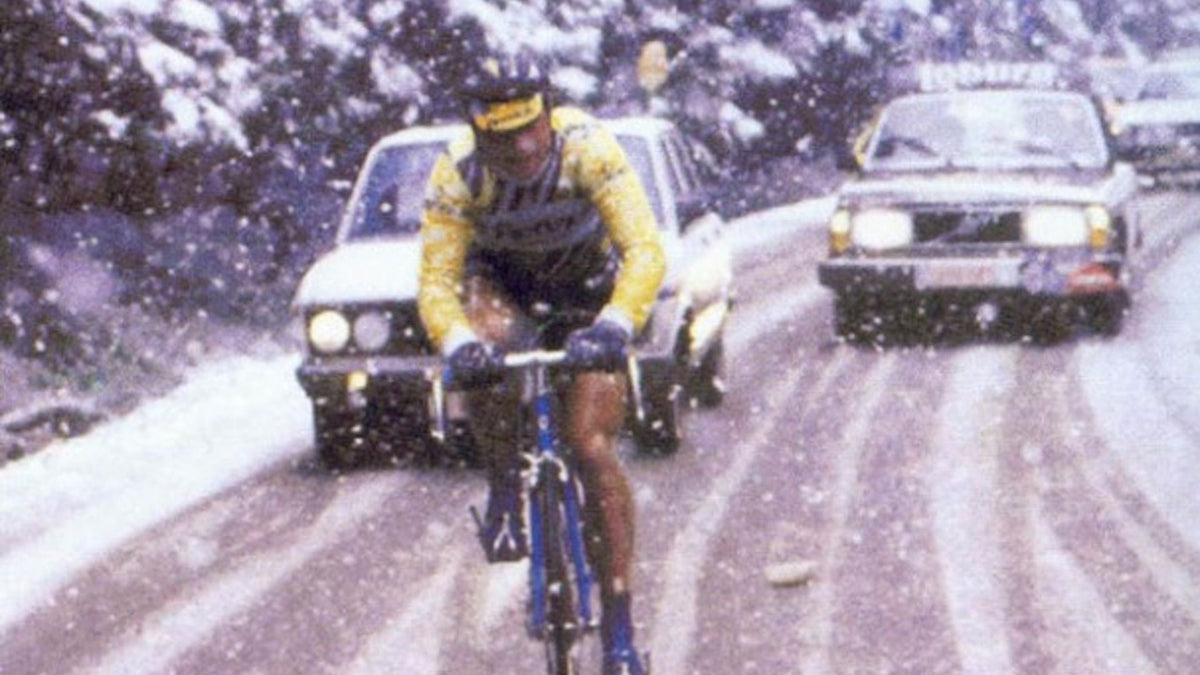
The photograph tells you Bernard Hinault kept riding. It doesn’t tell you how close he came to stopping.
Looking back on the 1980 Liège–Bastogne–Liège in a VeloNews interview, Hinault said a brief appearance by the sun helped persuade him to stay in the race. Without it, he thought he would have climbed off at the feed zone. The snow soon returned. [1]
That’s a useful place to begin a story usually presented as proof that Hinault could endure anything. He was cold. He was considering his options. For a little while, the weather gave him enough encouragement to continue.
Then he won by more than nine minutes.
April did not mean spring
The race took place on April 20, 1980. Of 174 starters, only 21 finished. Hinault arrived 9 minutes, 24 seconds ahead of Hennie Kuiper, with Ronny Claes third.
The UCI’s account describes a race broken apart by snow and cold, with Hinault eventually riding roughly the final 80 kilometers alone. That’s about 50 miles. He was already a two-time Tour winner and had won Liège in 1977, so the surprise wasn’t that he possessed the ability to win a major classic. It was the size and severity of this particular victory. [2]
The finishing numbers are easy to repeat and harder to absorb. More than 150 riders who started did not reach the finish as classified finishers. Whatever the usual race plan had been, the weather had made it provisional.
A course profile can show the hills. It can’t fully describe a day when getting to the next feed zone becomes a decision in itself.
There was still another rider helping him
In his 2020 interview, Hinault singled out teammate Maurice Le Guilloux for helping him during the first part of the race. He also described how little information riders had compared with the radio-connected peloton of later decades. He couldn’t simply ask for a complete account of who remained ahead or behind.
His recollection of clothing was equally plain: wool layers, a rain jacket, and gloves that offered much less protection than a rider would hope for in those conditions. [1]
Those details deserve some room in the story. Famous solo victories often become solitary from the start when they’re retold. The helper disappears, the uncertainty disappears, and the winner seems to have been executing a perfect plan all morning.
Le Guilloux’s presence puts some of the teamwork back. Hinault’s uncertainty puts the racing back. He was responding to what was happening around him, with incomplete information and a teammate doing what he could.
A huge margin can hide an untidy race
Nine minutes and 24 seconds looks decisive because it is. But the margin belongs to the finish. It doesn’t mean the whole day felt settled.
That distinction is easy to lose when history is reduced to a winner, a year, and a photograph. The result makes every earlier decision appear inevitable. Once you know Hinault won, the brief sunshine starts to sound like an omen instead of a small change in the weather that might have mattered to a freezing rider.
The more interesting version allows for chance. It also allows for the people who stopped. Their decisions don’t need to become evidence of weak character in order for Hinault’s ride to be exceptional.
Anyone who has turned around on a bad-weather ride knows how quickly the original plan can become irrelevant. You don’t need to compare that experience with a professional classic to understand the decision.
What the old image leaves us with
Hinault’s ride is part of the history behind the Renault–Gitane team, but it also sits alongside other races whose images have outgrown their details. Andy Hampsten on the Gavia is another example: a familiar frame becomes much more interesting when you restore the preparation, other riders, and actual result.
The snowy Liège deserves the same care. Remember the enormous winning margin. Remember the 21 finishers. Leave room for Le Guilloux, for incomplete information, and for Hinault admitting that he might have stopped.
The admission makes the victory easier to understand. A rider who never considered quitting would be a different character altogether. Hinault considered it, got a brief break in the weather, and kept going.
Sources
1. VeloNews — Bernard Hinault recalls his 1980 Liège victory
2. UCI — Hinault’s greatest classic victory