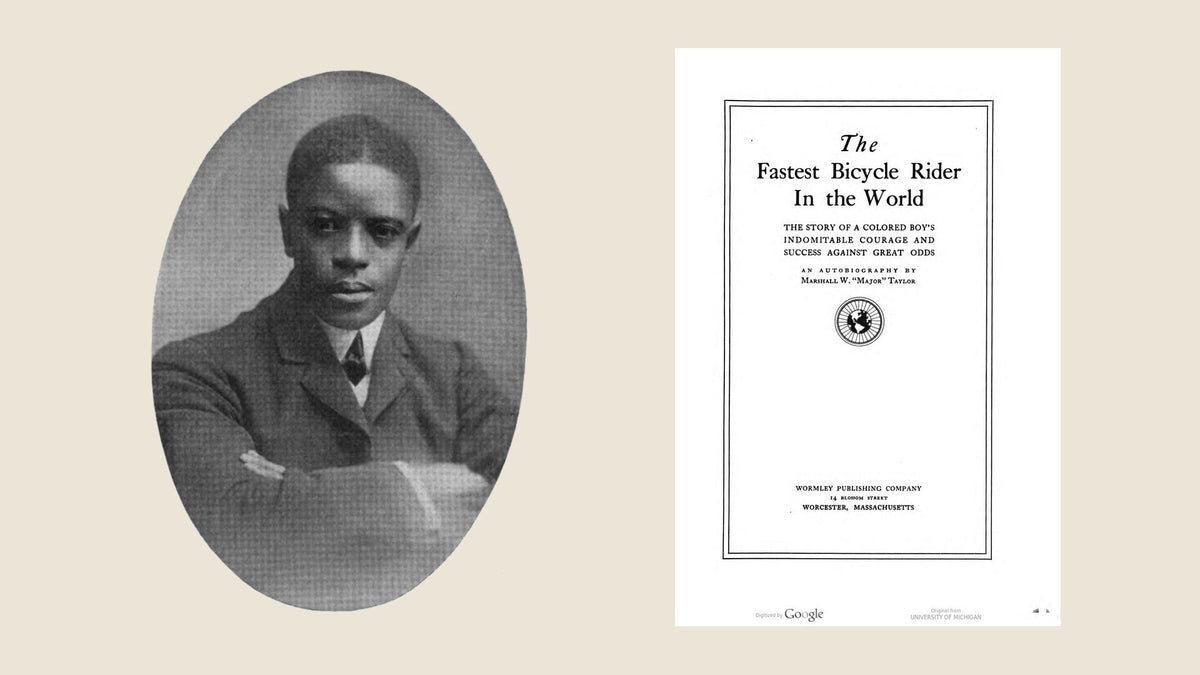
The Fastest Bicycle Rider in the World is a title with no interest in being modest.
It is also the title Marshall W. “Major” Taylor put on his autobiography in 1928. His name appears below it. The publication information places the book in Worcester, Massachusetts. Open the next pages and the great cyclist becomes a writer arranging the account of his own life.[1]
That change of position is worth lingering over. In a racing photograph, Taylor can be looked at. In this book, he decides where the reader should begin.
He begins, in part, with gratitude. The dedication addresses Louis D. “Birdie” Munger, the friend and adviser whose belief in him helped make his early opportunities possible. Munger had predicted that Taylor would become the fastest bicycle rider in the world. The cover returns to that prediction, now presented as an achieved fact.[1]

There is a particularly satisfying piece of editorial confidence in the arrangement: the boast outside the book is attached to a relationship inside it.
Taylor’s foreword then states why the record matters. He writes about what Black people can accomplish when granted fair opportunity, using his own results and those of other athletes as evidence. The demand for fairness is part of his account of sport, present at the entrance to the book. It is not something a later biographer has to attach as an interpretive label.[2]
By then, he had plenty of results to refer to. In 1899, Taylor won the world one-mile professional cycling championship. He also competed abroad and earned acclaim in Europe and Australia. The Indiana Historical Bureau’s documented chronology places those achievements alongside the discrimination he faced, rather than treating them as separate lives.[3]
The printed objects around his career show how widely a cyclist’s identity could travel. The Smithsonian preserves an Iver Johnson advertising button using his name and image. A sponsor could turn the rider into something small enough to wear. Newspapers could put him in front of readers who had never stood beside a track.[4]
His own book offers a different kind of proximity. The chapter list gives the career room to unfold, and the foreword insists on the author’s terms before the reader reaches the races. A person who has been advertised, cheered, obstructed, and described by others gets to set down his account.
This makes the 1928 volume an especially good object for a cycling archive. It can sit beside a jersey, a bicycle, or a race program without serving merely as supporting documentation. It has its own design decisions: an assertive title, a personal dedication, a statement of purpose. It asks to be opened.
Princeton has digitized a copy, and a transcription is available through Wikisource. Start with the title page. Then turn to the dedication before looking for a famous victory. Taylor put Birdie Munger there for a reason.
Cover image. The frontispiece portrait and title page of Major Taylor’s 1928 autobiography. Frontispiece from Major Taylor’s 1928 autobiography · Public domain · Major Taylor, 1928 · Public domain · resized and arranged side by side

Sources and further reading
- Major Taylor — The Fastest Bicycle Rider in the World, 1928
- Major Taylor — Foreword
- Indiana Historical Bureau — Marshall Major Taylor
- Smithsonian — Marshall Major Taylor
- Princeton Digital Collections — Taylor autobiography