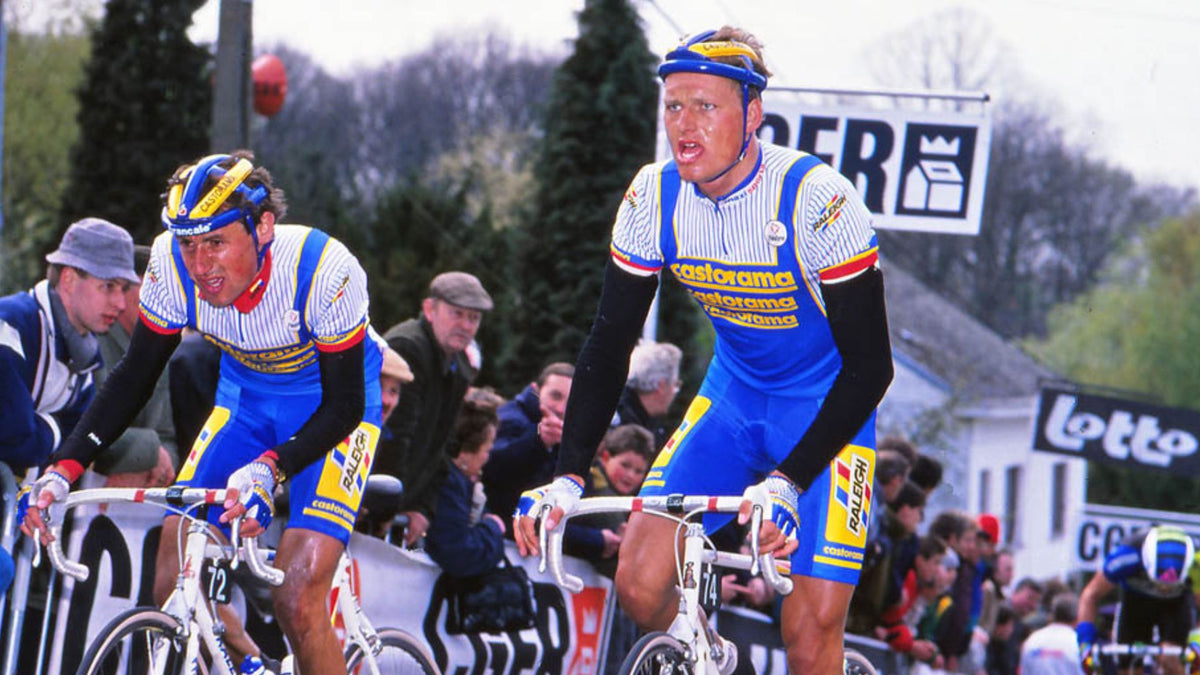
There’s a particular kind of confidence involved in sending professional cyclists to the Tour de France dressed like they’re about to hang drywall.
Castorama had it.
The French team’s jersey turned a hardware-store sponsorship into a visual joke you could understand without speaking French. Printed blue overalls sat over a yellow shirt. The straps were part of the graphic. Nobody was actually racing across France in workwear, although a quick glance at an old photograph might suggest otherwise.
It’s a wonderfully literal piece of advertising. Castorama sold home-improvement supplies. Its riders looked ready for a home-improvement project. Even among cycling’s stranger sponsor outfits, that idea still holds up. [1, 2]
A sponsor you could recognize from across the road
Plenty of jerseys make room for a company name. This one gave the company a costume.
Look at the design without reading the lettering. The blue shapes establish the overalls; the yellow fills in the shirt underneath. The effect depends on the whole outfit, rather than one especially clever logo. A cyclist bent over the bars becomes a moving illustration of the sponsor’s business.
That matters in a sport where the audience rarely gets a clean, front-facing view. Riders pass in bunches. Their clothing folds. A television camera catches a shoulder, then a back, then someone else’s wheel. Strong shapes have a better chance of surviving all that movement than a paragraph of small sponsor names.
Castorama’s answer was playful, but the job it was doing was serious. You remembered who was paying for the team.
The jersey also makes a good companion to Carrera’s printed denim. Both brought ordinary clothing into the visual language of professional racing. Carrera borrowed jeans. Castorama borrowed the clothes you might wear while fixing the kitchen. Neither was shy about the connection.
Thierry Marie gave the outfit a very long afternoon on television
The racing story worth pairing with this jersey happened on July 11, 1991.
On the Tour stage from Arras to Le Havre, Castorama rider Thierry Marie went away after roughly 25 kilometers. He then spent 234 kilometers alone at the front. That’s about 145 miles without a breakaway companion to take a turn in the wind.
Marie reached Le Havre first and took the yellow jersey. The Tour organizer’s retrospective describes an escape whose distance is still startling when you put it next to an ordinary weekend ride. This wasn’t a late attack made with the finish almost in sight. Most of his workday was still ahead of him when he left. [3]
The official-looking neatness of a result sheet can hide that distinction. One stage win occupies one line whether the winner waited for the final sprint or rode alone for hours. Marie’s line deserves a little more space.
The stage results record a winning time of 6 hours, 38 minutes, 27 seconds and a margin of 1 minute, 54 seconds. Those numbers give the escape its scale: an enormous amount of riding, followed by less than two minutes of breathing room at the finish. [4]
The joke never prevented anyone from taking the racing seriously
There’s a temptation to file a jersey like this under “funny old cycling stuff” and leave it there. The clothing is funny. The racing underneath it could be extraordinary.
That combination is part of the appeal. Modern eyes may read the printed overalls as novelty clothing, but Marie wasn’t appearing in a costume parade. The shirt belonged to the team supporting his attempt to win a Tour stage.
You don’t have to pretend the design is tasteful to appreciate it. In fact, calling it tasteful misses most of the fun. It commits to an idea with a directness that more restrained clothing rarely attempts.
There’s room in cycling for that. A sport with long hours of suffering, complicated tactics, and a very serious relationship with equipment can survive a jersey that makes people smile.
Castorama’s overalls deserve to be remembered for both reasons: they were a sharp piece of sponsor advertising, and somebody wore them while riding almost 145 miles alone to win at the Tour.
Sources
1. Cycling Weekly — The fabric of cycling and its iconic jerseys
2. Procos — Castorama and Brico Dépôt
3. Tour de France — Thierry Marie’s longest day
4. ProCyclingStats — 1991 Tour de France stage 6 results