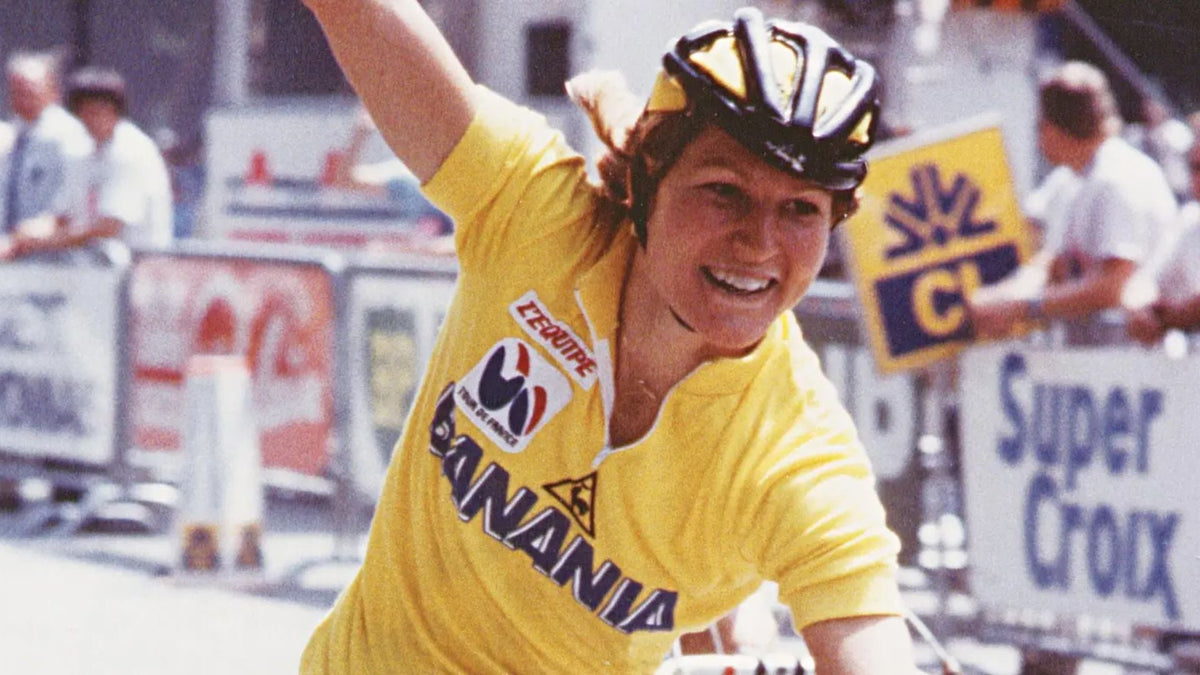
In 2019, a reporter visiting Marianne Martin described a Tour de France trophy doing a very ordinary job. It sat in Martin’s Boulder living room holding a credit card, an ornament, and a photograph of her mother.
Martin had won the 1984 Tour de France Féminin. Thirty-five years later, she was working as a photographer, and the trophy had become part of the furniture of an actual life. [1]
That detail is more revealing than another posed photograph of a champion holding a cup. A race can be enormous without becoming the only thing a person ever does. Martin’s victory deserves more attention, but she also deserves to be remembered as someone with a life on either side of the finish line.
An American victory with a less familiar name
Martin won the first edition of the Tour de France Féminin staged alongside the men’s Tour by its organizers in 1984. There had been an earlier women’s Tour in 1955, so calling her the winner of the first women’s Tour of any kind skips an important piece of history. [2]
The 1984 race covered 18 stages. It gave the women access to crowds already gathered for the men’s event, placing their racing in front of a much larger audience than a separate, less publicized competition might have reached. [2]
That setting is worth picturing carefully. The women weren’t riding an exhibition lap while everyone waited for the main event. They were contesting a stage race, with accumulated fatigue, daily results, and an overall classification to defend.
Martin’s name belongs in the story of American cycling’s arrival on that stage. It doesn’t require an asterisk pointing readers toward a more familiar man.
She had nearly walked away
An interview conducted in August 1984, later republished by VeloNews, puts the victory in uncomfortable financial perspective. The previous fall, Martin had been close to quitting. She described debts, multiple jobs, and the strain of paying her own way through racing.
Her form had also been uncertain. By her own account, she began the Tour hoping she could get through it, then found herself improving as the race went on. [3]
Read that interview and the victory stops looking like the scheduled arrival of an obvious favorite. The future winner didn’t have access to the future results. She had to make decisions with the same uncertainty that makes any difficult commitment feel risky.
It would be easy to turn that into a tidy lesson about believing in yourself. The financial details resist that treatment. Talent didn’t pay the bills in advance. Winning didn’t retroactively make the support adequate.
The mountains changed her race
Martin won two stages and the mountains classification. She finished 3 minutes, 17 seconds ahead of Helen Hage of the Netherlands, with American teammate Deborah Shumway third.
In the contemporary VeloNews interview, Martin described going to the front on a climb and gradually realizing she had ridden clear. The moment has none of the polished certainty that gets attached to a famous victory later. She was figuring out what she could do while doing it. [3]
The American result also extended beyond one rider. Cyclingnews’s retrospective, based on interviews with Martin and teammate Patty Peoples, records the U.S. squad’s victory in the team classification. [4]
That makes the story richer. A yellow jersey is easy to isolate in a photograph. The teammates around it are easier to crop out. Remembering the team result puts them back into the frame.
A champion does not owe us a permanent podium pose
Martin’s later interviews are striking partly because she doesn’t speak as if the rest of her life were an extended victory ceremony. In the 2019 conversation, she discussed photography, other athletic pursuits, and the difficulty of finding a life after competitive sport. [1]
That ordinary trophy on the shelf fits the picture. The achievement remained; the person kept moving.
For readers who know American cycling mainly through the 7-Eleven team or Greg LeMond, Martin offers another essential starting point. Her 1984 victory is a race worth learning on its own terms, with teammates, rivals, money problems, and a rider discovering her form in France.
The trophy could hold a few household odds and ends. The result still stands.
Sources
1. VeloNews — Amanda McCracken’s 2019 interview with Marianne Martin
2. NPR via GPB — Marianne Martin watches the return of the women’s Tour
3. VeloNews archives — The August 1984 interview with Marianne Martin
4. Cyclingnews — Remembering the 1984 women’s Tour with Martin and Peoples