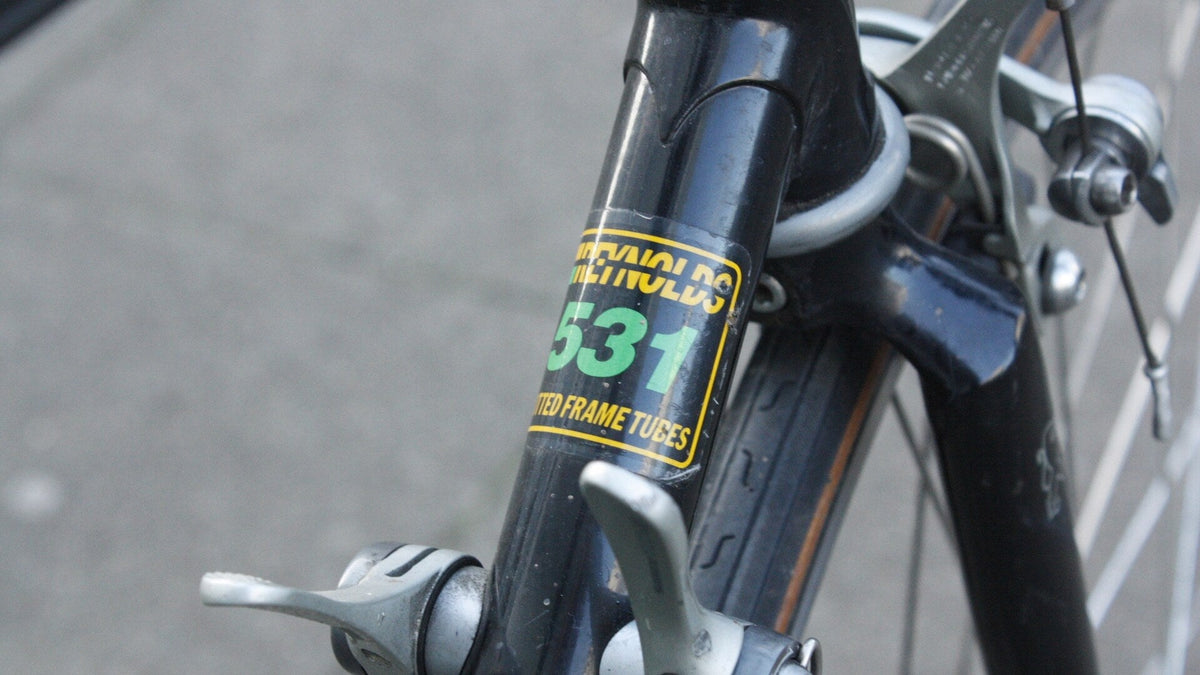
A bicycle can have an enormous maker’s name along its down tube and still make you lean toward a much smaller label.
Reynolds understood the value of that second look. On an early rectangular 531 decal reproduced in the company’s own design history, the name runs diagonally across the numbers. The border is tight. Small lettering fills the remaining space. This is an industrial specification with a remarkably busy sense of dress.[1]
The design is especially good at making the reader change distance. From a few feet away, you recognize the block of color and the familiar numerals. Close up, you start reading what the label actually says. Which tubes? Are forks and stays included? What wording accompanies the number?
That distinction matters because 531 is a material designation, not the name of a complete bicycle. Reynolds introduced the tubing in 1935. Its company history traces the business back to butted tubing and the early years of cycle manufacture. Frame builders would make very different bicycles with material supplied under the same name.[2]
So a tubing label has an unusual job. It identifies something that the finished paintwork largely conceals. The frame’s outside carries a statement about what is inside it.
Reynolds’s illustrated decal guide makes good desk reading for anyone interested in old bicycles. Across the examples, the sloping name gives way to other arrangements; the numbers become larger and clearer; the small print changes. The page places several generations beside one another, allowing the labels to be considered as graphics before a particular bicycle supplies the emotional attachment.[1]


The oldest-looking option is not automatically the best-looking one. A later decal with large green figures has its own blunt confidence. On a restrained frame, that small square can be the busiest thing in view. It deserves to be sharp enough to read in a photograph.
A label asks for supporting evidence
It is easy to let a familiar decal do too much work. A replacement can be applied after a repaint; a restored bicycle can wear a period-style label. The sticker alone cannot establish when the frame was built, who built it, or whether every part now fitted belongs to the same period.
Reynolds has published replacement-decal information as well as its historical guide. The existence of replacement labels is a useful reminder to read a bicycle as a collection of evidence. A serial number, construction details, an original catalog, and documented ownership may each contribute something different.[3]
None of that spoils the pleasure of the graphic. A well-chosen replacement can complete a thoughtful restoration. The important distinction is between appreciating a finish and using it to prove a history.
The decal also belongs to the paint around it. A rubbed edge or a surviving patch of color changes the way it reads. On an old frame, the small label occupies only a fraction of the surface, yet it can hold your attention longer than a much larger, perfectly preserved logo.
And before polishing away a worn original, take a photograph close enough to read the small print.
Cover image. A Reynolds 531 decal on a Peugeot road bicycle. Freehub Orchestra · CC BY-SA 4.0 · cropped

Related reading
Sources and further reading
- Reynolds — The development of the Reynolds decal style
- Reynolds — The History of Reynolds Technology
- Reynolds — Replacement decals