The trouble begins at the movies. François, a French village postman, sees a demonstration of American postal efficiency and decides to improve his own service. He has a bicycle. America, apparently, has rather more equipment.
That is the working predicament of Jacques Tati’s 1949 feature Jour de fête. The traveling fair has arrived, bringing entertainment and an unfortunate new professional ambition for the man who delivers the mail. François intends to go faster. His village has other things on its mind.[1]
It is an excellent setup for a cycling film, even though its central assignment is delivering the mail. Give a rider an ordinary job, then introduce an unreasonable idea of how quickly it ought to be done. Most of us can supply a modern version without much help.
Before the American example intervenes, François’s round includes stopping to help with hay and a flagpole. The BFI’s account of the film picks out these interruptions, which are important to the character: the postman is involved in the place he serves. His bicycle carries him between people who know him. The route has a social geography as well as a mileage.[2]


Then a screen offers him a new standard. Suddenly, the useful bicycle looks insufficient.
The attempts at improvement become gloriously physical. As the BFI describes one sequence, François pedals beside a truck and uses its tailgate as a desk to stamp his letters. The vehicle is moving, the postman is moving, and the paperwork must carry on. Elsewhere, his bicycle briefly takes him to the front of an actual race before a level-crossing barrier interferes.[3]
For a cycling journal, this is welcome territory. Professional racing supplies a great many photographs of men looking appropriately serious. François’s seriousness is the joke. His desire to improve is recognizable, even when the scale of the enterprise is absurd. The post office has not issued him a new engine. He has simply decided that his legs ought to behave like one.
The film also offers a useful escape from the usual visual shorthand for “vintage.” Its original audiences saw it in black and white, but Tati had also filmed in the experimental Thomsoncolor process. Technical problems kept that color version from release until a restoration completed in 1995. The BFI’s frame comparisons let you see the same village in both forms.[2]
The color images matter. Old cycling does not have to live inside a brown filter. A painted sign, a patch of clothing, or a fairground decoration can remain cheerfully specific. A scene may look old because of what is in it, without an editor pouring artificial age over everything.
Jour de fête belongs on the viewing list for anyone whose interest in bicycles extends beyond the finish line. Its great subject is an ordinary rider trying to accommodate a new idea of progress. That is a lot to ask of a postal round.
François still has the mail to deliver.
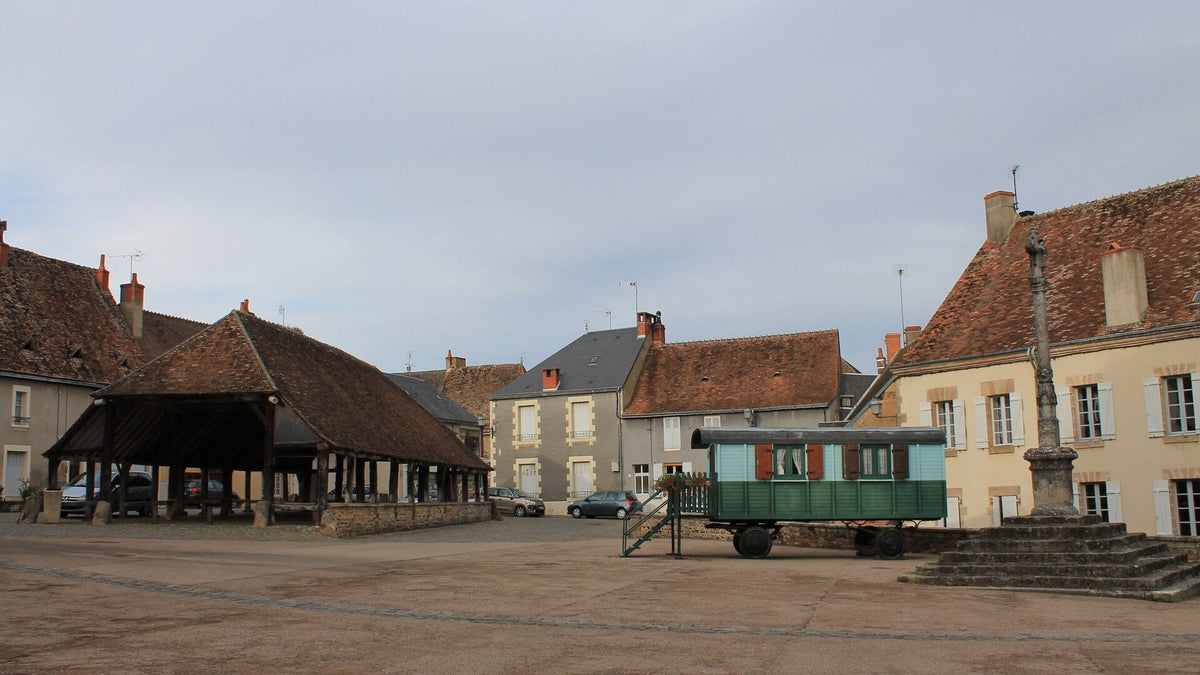
Cover image. Sainte-Sévère-sur-Indre, the French village used as the film’s setting. Allymcpatate · CC BY-SA 4.0 · cropped

Related reading
Sources and further reading
- Festival de Cannes — Jour de fête
- BFI — Painting the town: Tati’s Jour de fête in colour
- BFI — A user’s guide to the modern world according to Jacques Tati