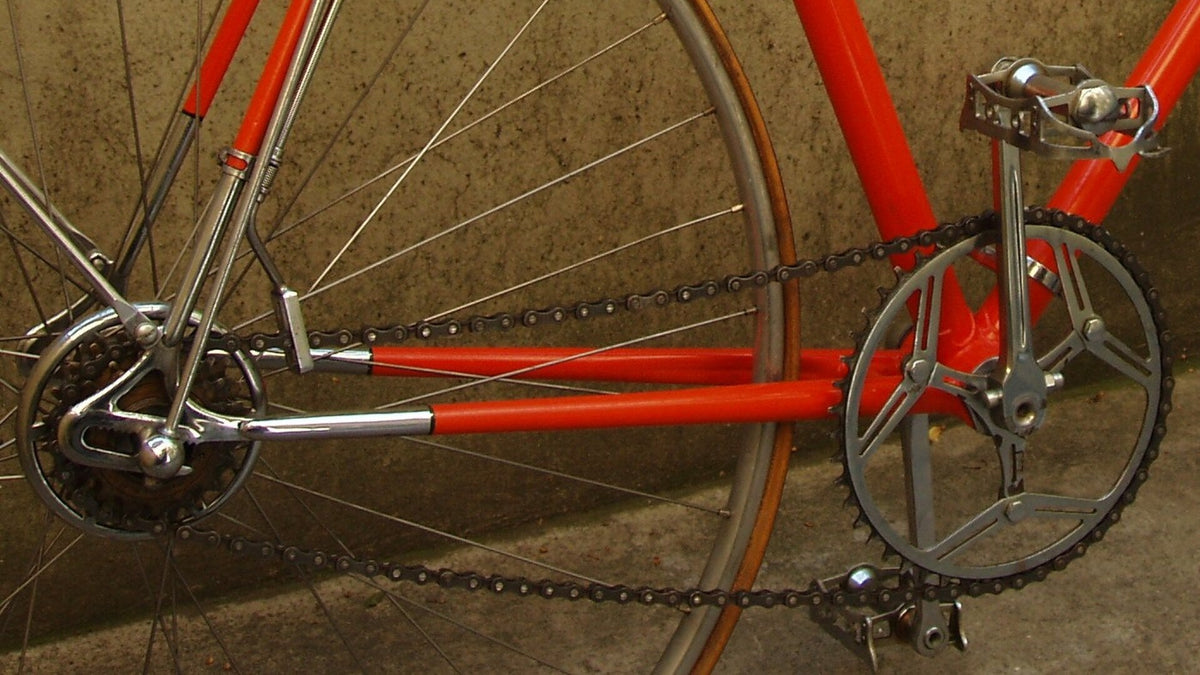
In Campagnolo’s Catalog No. 13, a gear system arrives as a small population of parts. Hubs, rods, washers, axles, and fittings have each been drawn and assigned a number. The customer is expected to order accordingly.[1]
The drawing of the Cambio Corsa rewards an unhurried look. Two long control rods sit beside the hardware for the rear wheel. They have the lean, purposeful appearance of something you might find attached to an old machine tool. On a bicycle, they run up the right side of the rear triangle, putting the controls within reach behind the rider.
This is a wonderfully awkward place for a modern eye to find a gear change. We tend to look at the handlebars first. On this machine, the important conversation happens down by the rear axle.
The rod-operated system belongs to a period when shifting could involve releasing the rear wheel’s clamp, moving the chain while backpedaling, allowing the wheel to change position, and securing it again. The later single-lever Paris–Roubaix system combined operations that the preceding two-lever arrangement separated. The Italian patent-office catalog describes the underlying principle as unlocking and relocking the driving wheel around a change of sprocket; the museum record for the later model explains the backpedaling and special rear dropouts.[2][3]


Even that short description makes you glance at the brake levers with renewed affection. Here was a component that asked its owner to understand what was moving.
The attraction today lies partly in that visibility. There is no need to invent a mysterious quality in the steel. A rod goes somewhere. A lever operates something. You can follow the arrangement with your eyes, then discover that following it is easier than imagining yourself using it during a race.
The old catalog makes the relationship between admiration and maintenance unusually plain. A photograph of a champion might sell the system; the adjacent parts drawings tell a shop what will be required to keep it working. The same pages accommodate sporting prestige and the extremely unglamorous business of specifying a replacement nut.
That practical language deserves to survive alongside the racing photographs. A complete vintage bicycle can become so polished and carefully lit that it looks as if it has never needed anything. An exploded drawing restores the possibility of a missing piece. It allows the machine to be repaired in the imagination before anyone reaches for a tool.
The catalog even makes room for differences between older and newer fittings. It is addressing people who may already own the equipment and need the appropriate replacement. The bicycle outside the shop could have a champion’s name on the frame. Inside, the question would be which small part to order.[1]
There is no need to stage a demonstration on the road. The catalog is quite absorbing enough at the kitchen table. Follow a number from the drawing into the list, find the part, then go back and look for it on the machine. By the third or fourth item, that polished bicycle has become a collection of decisions.
Cover image. A Campagnolo Cambio Corsa system fitted to an Olmo bicycle. Gorgolo286 · Public domain · cropped

Related reading
Sources and further reading
- Campagnolo Catalog No. 13 — scan and transcription hosted by Ebykr
- Italian Patent and Trademark Office — Italy, Land of Patents
- Lombardia Beni Culturali — Campagnolo rod-operated gear