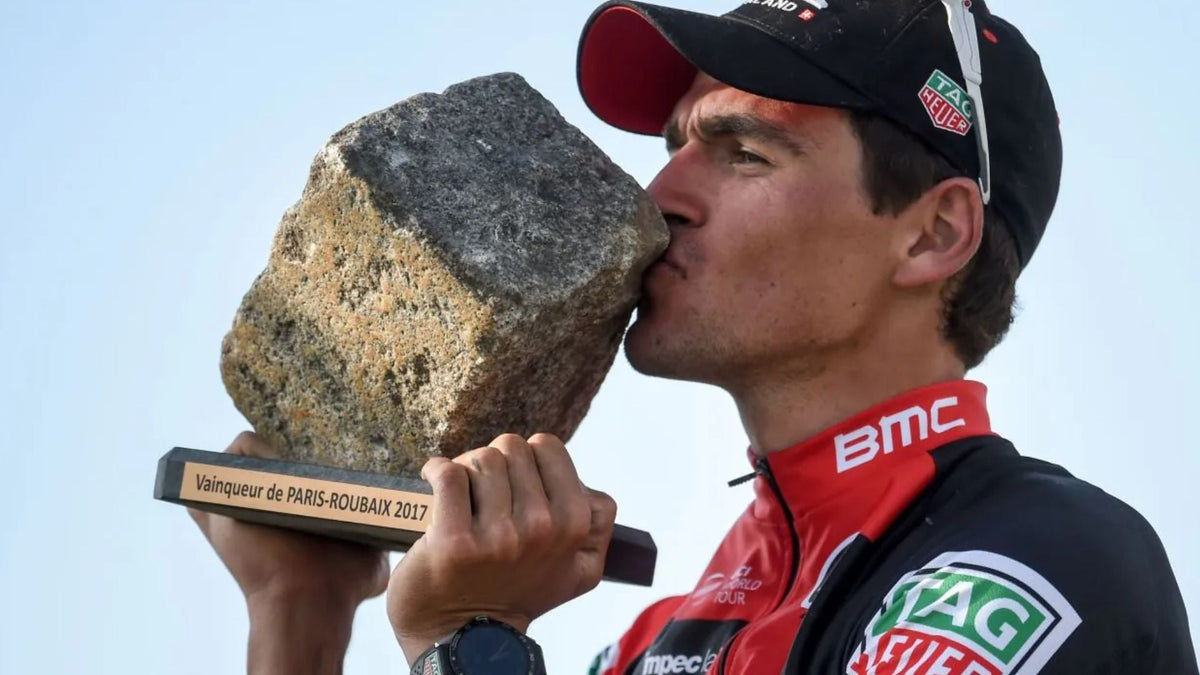
Some trophies look expensive from the other end of the room. The Paris–Roubaix trophy looks heavy.
A rough block of granite sits on a polished base. There are no handles, no graceful silver bowl, and very little attempt to disguise what it is: a paving stone. Since 1977, that has been the prize presented to the winner of the men’s race. [1]
It’s hard to imagine a more suitable object. By the time a rider reaches the velodrome, the road has occupied enough of the day. Giving the winner a piece of it feels almost inevitable.
But the trophy is younger than the race, and the cobbled roads it represents have needed people willing to preserve them. The rock has a history beyond the podium photograph.
A practical object with a second career
The trophy’s stone is a granite sett: a worked block of the kind used to pave a road. Cycling commonly calls these stones cobbles, which is how the trophy has become known.
Chris Sidwells’s account for Cycling Weekly connects the survival of northern France’s cobbled roads with the region’s industrial past. As smoother surfaces replaced them on main roads, the race increasingly sought out the smaller lanes where the older paving remained. [1]
That changes how you look at the trophy. It represents an ordinary piece of infrastructure given an extraordinary sporting role.
A stone doesn’t need to know it is part of cycling history. It just has to sit in the road. The historical meaning comes from what happens over it, what people remember, and whether anyone bothers to keep it there.
Roger De Vlaeminck won Paris–Roubaix in 1977, the year the cobblestone trophy was introduced. It was his fourth victory in the race, following wins in 1972, 1974, and 1975. [2]
The prize may have been new. Its first recipient already understood the terrain.
The people who repair the rough road
Les Amis de Paris–Roubaix, founded in 1977, helps preserve the race’s cobbled sectors. A report by the KOERS cycling museum describes volunteers working with partners that include students and teachers from the horticultural school in Lomme.
Their work includes restoring sections of paving so they can remain part of the course. The road doesn’t stay raceable simply because it is old. [3]
There’s a nice tension in that job. These are people caring for a surface famous for making riders uncomfortable. Maintenance preserves the character of the road without treating every missing or displaced stone as a charming historical feature.
That labor rarely gets the same attention as a puncture, an attack, or a rider covered in mud. Still, without maintained sectors, the race would gradually lose the thing its trophy celebrates.
A podium photograph shows the winner holding one stone. The volunteers are concerned with all the stones left behind.
The name came from a different kind of destruction
“Hell of the North” sounds like an obvious description of riding over rough pavement. The name has a more specific and much grimmer origin.
The race organizer traces it to 1919, when the route was examined after World War I and the devastation of the region confronted those traveling through it. The hell in the description was the wrecked landscape left by war. [4]
That history should stay attached to the phrase. It gives the race a connection to its setting that goes beyond a sporting nickname.
The difference matters even in a short caption. A hard bike race and a landscape devastated by war are not interchangeable subjects. Knowing where the name came from makes the local history harder to overlook.
A trophy that makes sense without an explanation
You could hand someone a picture of the cobblestone trophy before explaining any of this, and the basic idea would still land. The winner has earned the road.
The extra history makes the object better. It brings in an industrial region, a race adapting its route, a champion receiving a new kind of prize, and volunteers keeping old paving in use.
For another part of the race’s visual history, read about Mapei’s distinctive jersey. The clothes change from team to team. The stone remains a wonderfully blunt way of recognizing what everyone came to do.
Sources
1. Cycling Weekly — The Paris–Roubaix cobblestone trophy
2. Paris–Roubaix — Official race history and winners
3. KOERS — Les Amis de Paris–Roubaix
4. Paris–Roubaix — The 1919 origins of the Hell of the North name