The destination came before the departure by more than twenty years.
Dervla Murphy was ten when a bicycle and an atlas arrived as birthday presents. Soon afterward, on a hill near her home in Lismore, County Waterford, she decided to cycle to India. The pairing had done its work. One present showed her the distance; the other gave her a means of covering it.[1]
A child could be forgiven for leaving the idea there. Murphy kept it.
In the foreword to Full Tilt, she explains the choice with a wonderfully practical concern: an overland journey toward India presented fewer stretches of water than some other destinations at a comparable distance. This was a geographical problem that could be considered. The bicycle was already available as a solution.[2]


The long wait gives the story its shape. Murphy eventually set off in 1963, at thirty-one. The girl with the atlas had become a woman with responsibilities and years behind her. A later Condé Nast Traveller profile identified the machine for the journey as an Armstrong Cadet. It had a name, Roz, which is how a bicycle stops sounding like an item on an equipment list.[2][3]
Full Tilt followed in 1965. The subtitle, Ireland to India with a Bicycle, leaves room for both the traveler and her companion. “With” is a generous little word. A book called Ireland to India by Bicycle would sound more like a transport achievement. Murphy’s title makes the machine part of the company.
Her route took her through Iran, Afghanistan, Pakistan, and India, among other countries. The publisher describes the book as arising from the daily diary of the journey. That matters more to its appeal than assembling a retrospective list of dangers. A diary belongs to a person who still has tomorrow’s arrangements to make. The destination cannot tidy up every difficulty in advance.[2]
It is tempting to package Murphy as an advertisement for fearlessness. The travel stories are extraordinary, and the famous pistol makes an irresistible headline. But the bicycle and atlas are the better opening objects. They explain the persistence of an idea before anyone knew there would be a book to sell.
There is also no need to turn her luggage into a shopping prescription. Someone buying a touring bicycle now is facing a different journey, with different choices. Roz’s interest is biographical. A specification sheet could never explain why this particular machine acquired a place in a writer’s life.
That place became quite literal. In 2022, Waterford’s library service announced a display of Roz at Lismore Library. Murphy had donated the bicycle to the library established by her father, Fergus, the county’s first librarian.[1]
The arrangement has a pleasing lack of grandeur. A bicycle can sit among books without needing to resemble a racing trophy. People can come looking for a writer and find the thing that carried some of the weight.
Readers came to Lismore for her books. Roz was there, too.
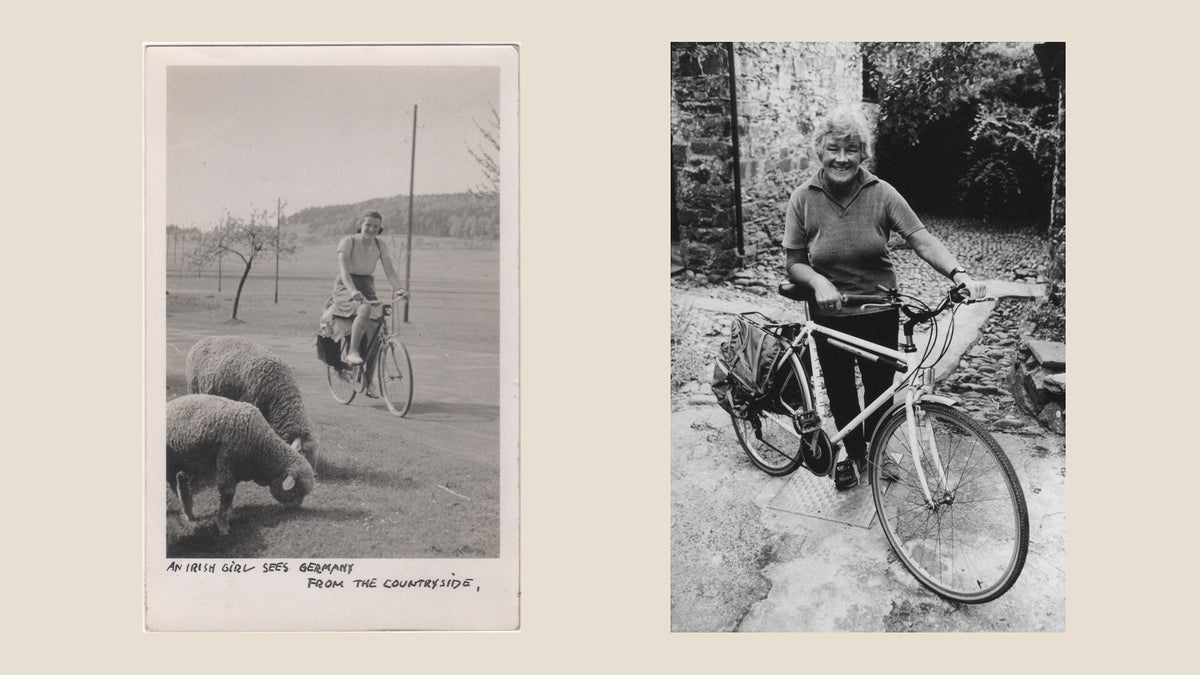
Cover image. Dervla Murphy in Bavaria in 1952 (left) and with a bicycle in 1994 (right). Unknown photographer / Eland Books · CC BY 4.0 · John Minihan / Eland Books · CC BY 4.0 · resized and arranged side by side

Sources and further reading
- Waterford Libraries — Roz on display at Lismore Library
- Eland — Full Tilt, including Murphy’s foreword
- Condé Nast Traveller — Dervla Murphy
- National Library of Scotland — Dervla Murphy papers
- Open British National Bibliography — Full Tilt