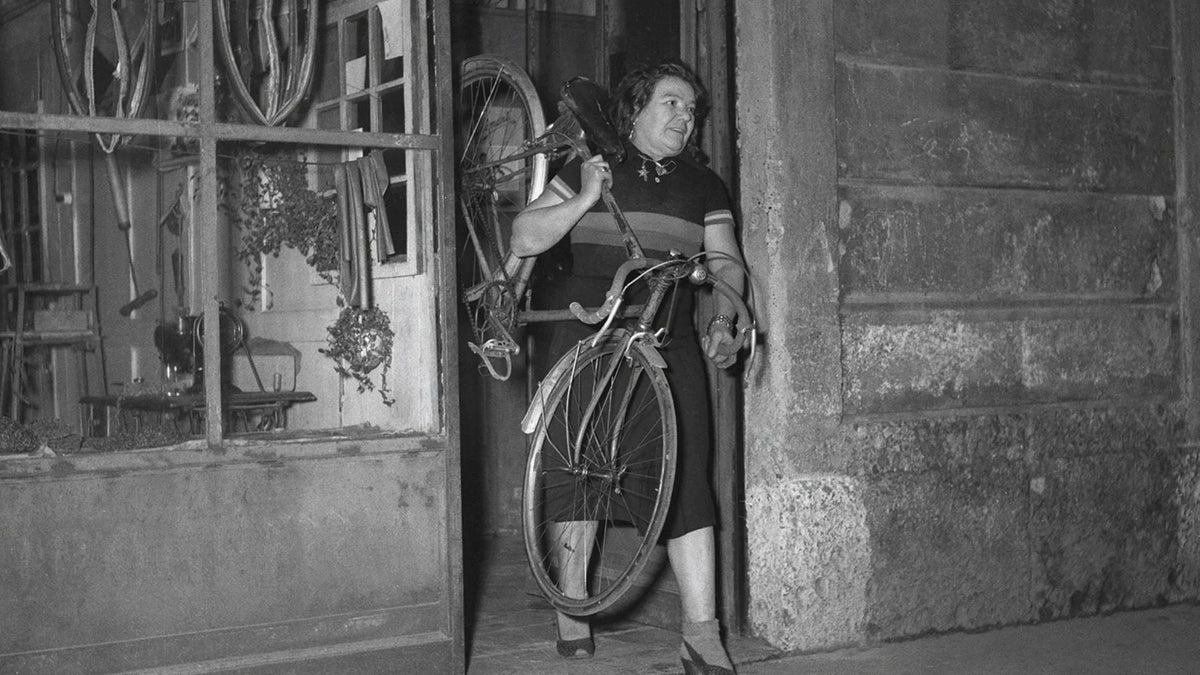
Alfonsina Strada reached Milan at the end of the 1924 Giro d’Italia. She did not appear in the final official classification.
Both statements belong in her story.
After arriving beyond the time limit at Perugia, Strada was excluded from the standings but allowed to continue along the route. The Giro’s own historical archive makes that distinction clear. [1]
It’s tempting to smooth it out when telling the story of the woman who rode the Giro. Calling her an official finisher gives the tale a simpler ending. It also changes what happened. Her decision to continue is interesting enough without rewriting the results.
She was already a cyclist
By 1924, Strada had years of riding and racing behind her. The Giro organizer’s retrospective describes a woman who developed an early attachment to bicycles, competed despite the restrictions of her time, and worked as a seamstress. Her husband, Luigi Strada, supported her racing and gave her a racing bicycle as a wedding gift. [2]
Those details help correct another habit in the way her story is told. She didn’t materialize at the start as a symbol waiting for a historian to explain her. She was a working person who wanted to race a bike.
That desire is easy for a cycling audience to understand. The barriers around it were specific to her circumstances. Holding both ideas together gives her more room than the usual shorthand about a remarkable woman doing something nobody expected.
An unusual Giro created an opening
The 1924 edition took place amid a dispute that kept major teams and leading riders away. The race was eventually won by Giuseppe Enrici. Strada started wearing number 72. [1]
That background matters. Her opportunity did not arrive because the entire sport had suddenly agreed to treat women equally. It emerged within an unusual edition of an existing men’s race.
The public response added another complication. Bologna’s Biblioteca Salaborsa records that her participation initially received limited acknowledgment before attracting considerable interest. The library’s account also preserves evidence of the condescension surrounding that attention. [3]
Being noticed and being respected are different experiences. Strada could be a serious rider while people around her treated her presence as a curiosity. The two things could happen at the same time, and apparently did.
The road to Perugia
The Giro organizer’s account describes the stage from L’Aquila to Perugia as 296 kilometers long, about 184 miles. Strada crashed, damaged her handlebar, and, according to that retrospective, used a broom handle in the repair. She arrived after the time limit.
Emilio Colombo, director of La Gazzetta dello Sport, helped support her continued journey. She could keep riding, but her place in the official competition was gone. [2]
The broken handlebar is the kind of detail that tends to take over a story. It is vivid and easy to remember. The classification decision deserves equal attention, because it explains the unusual status of everything that followed.
Continuing outside the standings did not erase the difficulty of the remaining road. It changed what the race would record. Strada still had to decide whether reaching Milan was worth the effort when the result sheet would no longer include her.
The following year did not provide a tidy sequel
According to the Biblioteca Salaborsa account, her entry was refused in 1925. [3]
That is an important part of the ending. One highly visible appearance did not turn immediately into a lasting opportunity. Stories of pioneers often stop at the first open door because the next closed one complicates the celebration.
Strada’s ride remains an achievement without pretending it solved the problem around her. We can admire her persistence and acknowledge how limited the opening was.
There is another historical detail worth remembering when imagining the scene: this was before the Giro introduced its pink leader’s jersey in 1931. The familiar maglia rosa story belongs to a later chapter.
For Strada, the image to hold onto is less tidy: number 72, a very long road, and a rider continuing after the official standings had left her behind. Reaching Milan mattered even when it couldn’t become a finishing position.
Sources
1. Giro d’Italia historical archive — The 1924 edition
2. Giro d’Italia — Alfonsina Morini Strada and the Perugia stage
3. Biblioteca Salaborsa — Alfonsina Strada at the 1924 Giro