The Beatles played the Vigorelli in 1965. Fausto Coppi had already made the place famous on a bicycle.
Put those two uses of a Milan venue beside one another and the building becomes easier to understand. People came to see somebody perform. The wooden track supplied the particular geometry for one kind of performance; the crowd supplied a great deal of the rest.[1]
The Vigorelli opened for racing in 1935. Its history is full of champions, but the venue itself is the first thing to look at: an oval with steep banking, seating around it, and an infield that makes the movement legible. A rider goes away and comes back. Spectators can follow an effort without waiting for the race to emerge from a distant road.[1][2]
This repetition changes the visual character of cycling. On a mountain, the scenery can swallow the rider. On a track, the same jersey returns to the same stretch of boards. Clothing becomes a moving point of recognition within a relatively fixed picture.
Pirelli’s archive photographs show the Vigorelli as a working stage. In one, Coppi appears with Antonio Bevilacqua at the 1950 Pirelli Grand Prix. Another records the competition in 1955. These pictures are useful partly because they have more to offer than an isolated famous face: bicycles, advertising, spectators, and the arrangement of the venue all belong to the occasion.[3]
The hour record concentrated the track’s appeal into a particularly severe format. Coppi set his 1942 record there. The attempt needed no distant finish town to give it shape. Rider, track, and clock supplied the terms. The UCI’s history places the Vigorelli at the center of a remarkable succession of hour-record performances in the middle decades of the twentieth century.[2][3]


Yet it would be a mistake to turn the building into a silent monument to those attempts. Its other uses are part of the attraction. The venue committee records the Beatles’ two performances on June 24, 1965, among later concerts and civic gatherings. A place with that history belongs to a city as well as to a sport.[1]
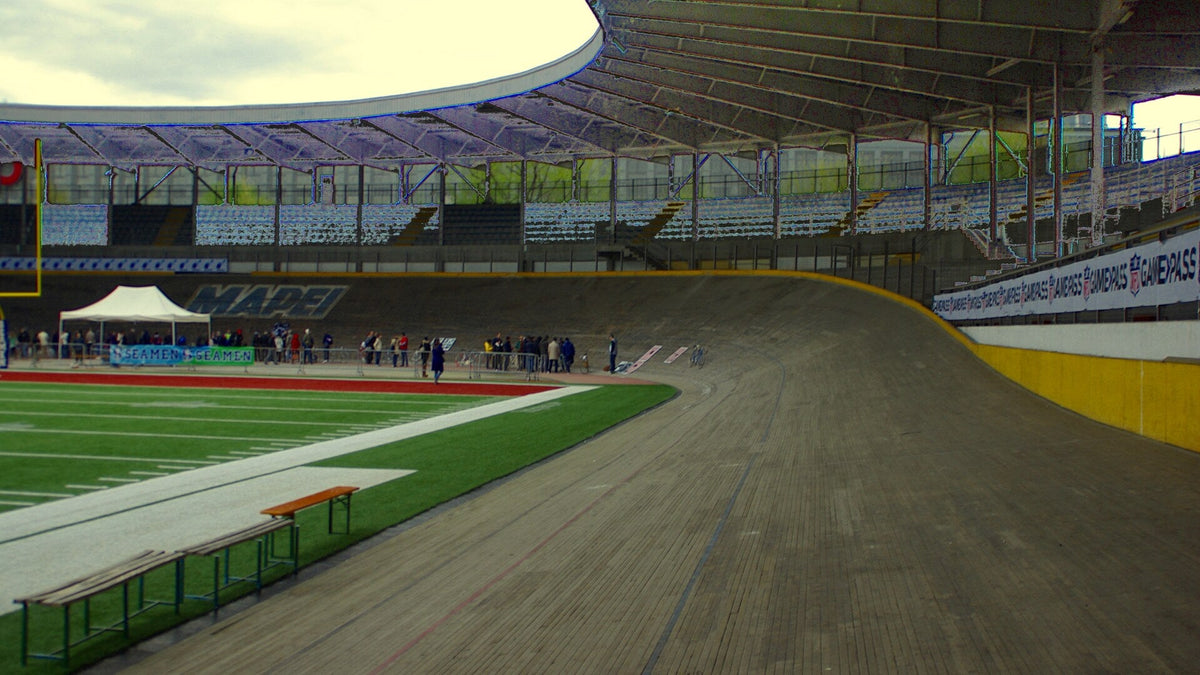
That is why a photograph of the empty banking can be more evocative than a collage of champions. It leaves the stage available. The boards still describe where a rider would go, while the seats describe where other people would watch.
The venue also endured war damage, reconstruction, and periods of decline. Its history was never simply one long sellout crowd. Later efforts to bring cycling back to the track form part of the record kept by the UCI and the local committee.[1][2]


A building with so many uses resists being frozen at the date of its most famous sporting achievement. Its seats have held people with different reasons for being there. Some came to follow the same rider around the banking, lap after lap. On June 24, 1965, the ticket buyers came for the Beatles.
Cover image. The wooden banking inside Milan’s Vigorelli in 2014. Bramfab · CC BY-SA 3.0 · cropped

Sources and further reading
- Comitato Velodromo Vigorelli — Storia
- UCI — Vigorelli, a velodrome for the citizens
- Pirelli — The Vigorelli, the history of cycling carved in wood