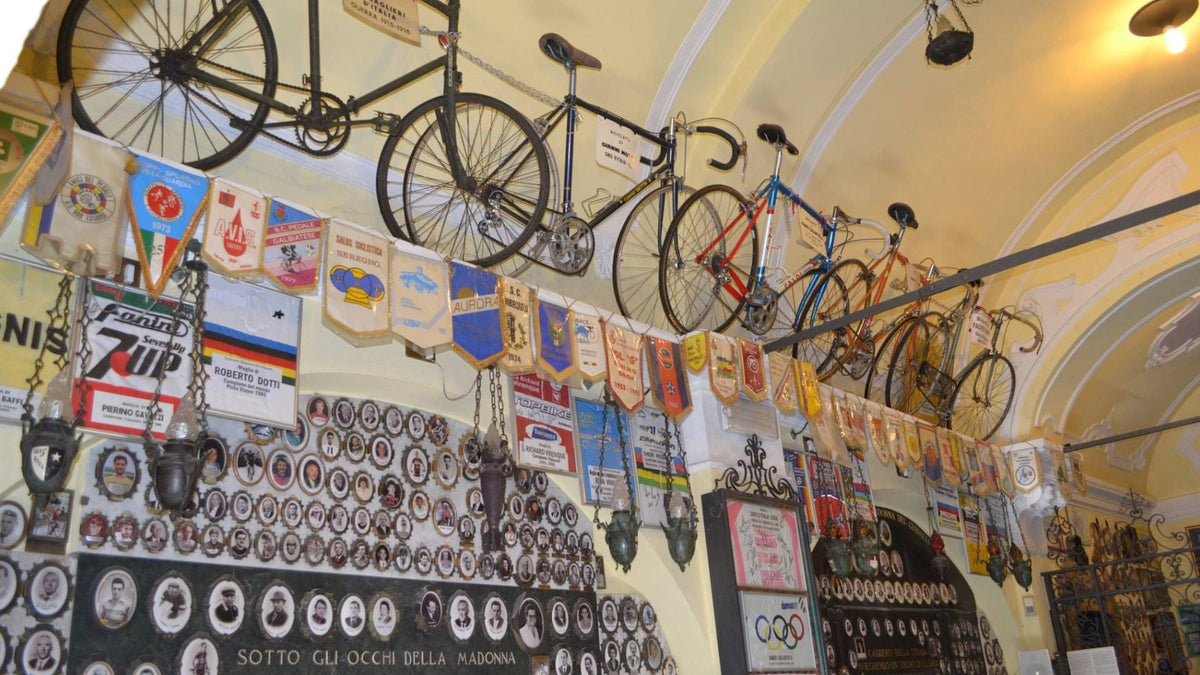
A bicycle usually belongs somewhere it can be ridden. Put one inside a chapel, alongside jerseys and other reminders of racing, and it asks to be looked at differently.
At Madonna del Ghisallo, in Magreglio above Lake Como, that unlikely meeting has become part of cycling’s history. The sanctuary holds bicycles and jerseys associated with the sport. Nearby stands a separate cycling museum, opened in 2006. [1, 2]
The distinction is useful before you go any further. The chapel and the museum are neighbors, but they aren’t the same place. One is a religious sanctuary with a deep connection to cyclists. The other provides space to collect, explain, and exhibit the sport’s material history.
Together, they make a good case for keeping objects after their working lives are over.
A climb before a destination
Ghisallo also belongs to the history of Il Lombardia.
The race organizer dates the climb’s first appearance to November 2, 1919. Costante Girardengo was the first rider over the summit that day. Decades later, the climb became closely associated with Fausto Coppi, who led over it in each of the editions from 1946 through 1950. [3]
That last detail is worth reading precisely: leading over the climb and winning the race are different results. Old cycling stories often compress a route, a summit, and a finish into one heroic moment. Ghisallo deserves to remain a place along a race, with its own events, rather than a convenient substitute for the entire result.
For someone arriving by bike, that layered history is part of the attraction. You can be thinking about a road gradient one minute and an old racing photograph the next. The same place accommodates both kinds of attention.
How a chapel became part of cycling
In 1949, Pope Pius XII proclaimed the Madonna del Ghisallo patroness of cyclists. The museum’s account places the sanctuary’s connection with the sport at the center of the site’s identity. [1]
The religious meaning belongs to the people who bring it. Other visitors may approach through racing history, affection for old bicycles, or simple curiosity. You don’t have to assume that everyone experiences the place in the same way to understand why it matters.
A jersey displayed in this setting has a different presence from one shown in a catalog. It has been removed from the moving crowd where it once served as identification. The visitor can stop, look at its scale, and consider the person who wore it.
That slowing down is part of what a physical collection can offer. An online photograph is easy to scroll past. An object occupies space with you.
The museum widens the story
The modern museum was founded by Fiorenzo Magni and opened in October 2006. Its stated purpose reaches beyond celebrating famous champions. It includes the wider cycling world: women and men who ride, the people who support racing, and cycling as part of everyday life. [1]
That broader approach is welcome. A sport told only through winners leaves a lot of people outside the door.
Mechanics, organizers, team staff, and ordinary riders help explain how bicycles become part of a culture. Their work and habits give the famous victories somewhere to happen. A collection that makes room for them can show more than a sequence of champions replacing one another.
For Retrolica readers, the appeal of old jerseys and cycling memorabilia will be familiar. Ghisallo adds a different question: what does it mean to preserve these things together, in a place people deliberately travel to see?
Leave room to look
If you’re planning a visit, check the museum’s current opening information and any temporary exhibitions directly. Give the chapel and museum separate time, and treat the sanctuary as a place of worship. Those small decisions will make more sense than approaching the whole site as a quick photo stop.
You could also choose one object to spend a little longer with. Look at its proportions, repairs, lettering, or wear. Ask what the display tells you and what you still don’t know. There’s no prize for recognizing every bicycle in the room.
Ghisallo offers plenty of famous names. Its quieter appeal is that the objects remain after the noise of a race has gone. A bicycle that once needed to keep moving can stand still long enough for someone else to pay attention.
Sources
1. Museo del Ghisallo — Museum history and mission
2. Museo del Ghisallo — The sanctuary and cycling setting
3. Il Lombardia — The Ghisallo climb and its racing history